
Category: Management
Signal Employee Tenure Analysis and Succession Planning

In response to a suggestion that succession planning within the Signal discipline may be an issue at one unionized transit property, we were tasked to determine the nature of the shortage and how this issue could be addressed. We examined various data sources including history of bidding and bumping, seniority lists, promotional paths, personnel action reasons, and headcount trends, and interviewed many subject matter experts (SMEs) who have day-to-day responsibilities in these areas. What we discovered was a complex picture of many different factors that contribute to this perception: at the less technical grades, training of replacement workers was keeping up with demand but there is a constant churn of personnel due to this disciplines being particularly desirable candidate for positions in other crafts with higher remuneration but requiring similar skillsets and having comparable responsibilities. Additionally, due to the general decline in quality of skilled craft training in the education marketplace, the hiring process, and low initial pay under a step system, new recruits were having a more difficult time passing the required tests, resulting in a higher failure rate. There was some movement resulting from desire to work closer to home early on in their career, but these employees, once settled down, tend to stay within their districts. At the higher technical level, there were fewer positions and they tended to be populated by high seniority employees because they are desirable positions, as a result many employees at this level have few years left to serve once they had attained these positions and completed the necessary complex technical training; therefore the retirement of each senior and highly technical employee is more noticeable to those who are responsible for ensuring that the work is covered. Our recommendation was to continue to train at the less technical level and simply create a pipeline of eligible candidates, whereas increase the position count at the higher technical levels both to provide a larger pool of qualified workers and to provide more opportunities/incentives for mid-career employees to stay within the discipline. This would also have the incidental benefit of reducing overtime costs and potential employee burn-out at the highly technical level.
Visual Interfaces for Real-Time Customer Information Systems
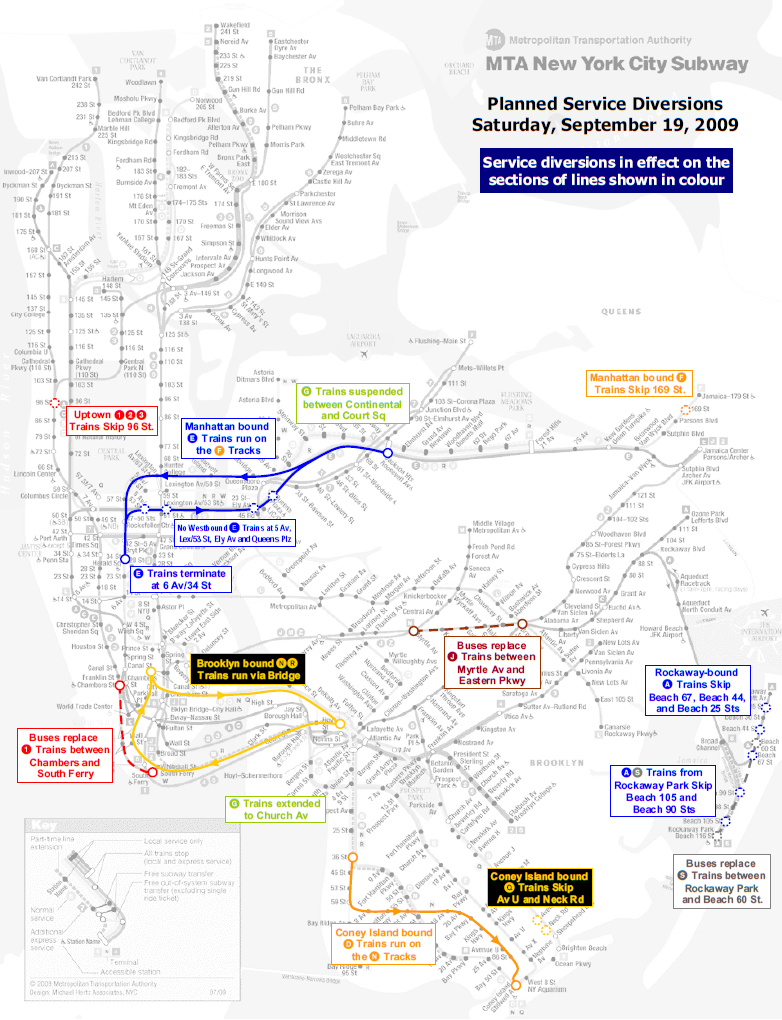
 For a subway line general manager (LGM), we designed and prototyped customer communication visual interfaces for use at senior management meetings where these alternatives were debated and systemwide standards set. At that time, the subway was being managed as a number of stand-alone lines and each LGM were responsible for their own area as well as pushing initiatives to improve systemwide best practices. We provided prototypes for a map capable of communicating planned service changes, and an interface for a customer information system (designed for use in subway stations) capable of displaying system status in real time, as a strategy to promulgate this practice. We performed industry-wide research to ascertain if similar products already existed and sought to keep the design consistent with other operator where this was possible. However, due to the uniquely complex subway system in this city, this was not possible for the service change map, and a brand new design had to be created. The real-time status display was based on systems already in common use within the airline and mainline passenger railroad industries, giving customers a sense of familiarity. Later we provided a functioning prototype to assist decisionmakers in visualizing and advancing a pilot project. In both cases, the communication initiatives advanced by the LGM were eventually adopted by the system and further development by outside vendors took place based on our prototype designs.